

Community Forum @ Katikit in Kenya's Rift Valley

This summer, our colleague Jane met with families and community members at Katikit School in Baringo County (Rift Valley), Kenya, as we continued developing plans for a regenerative agriculture and education project centered around the school.
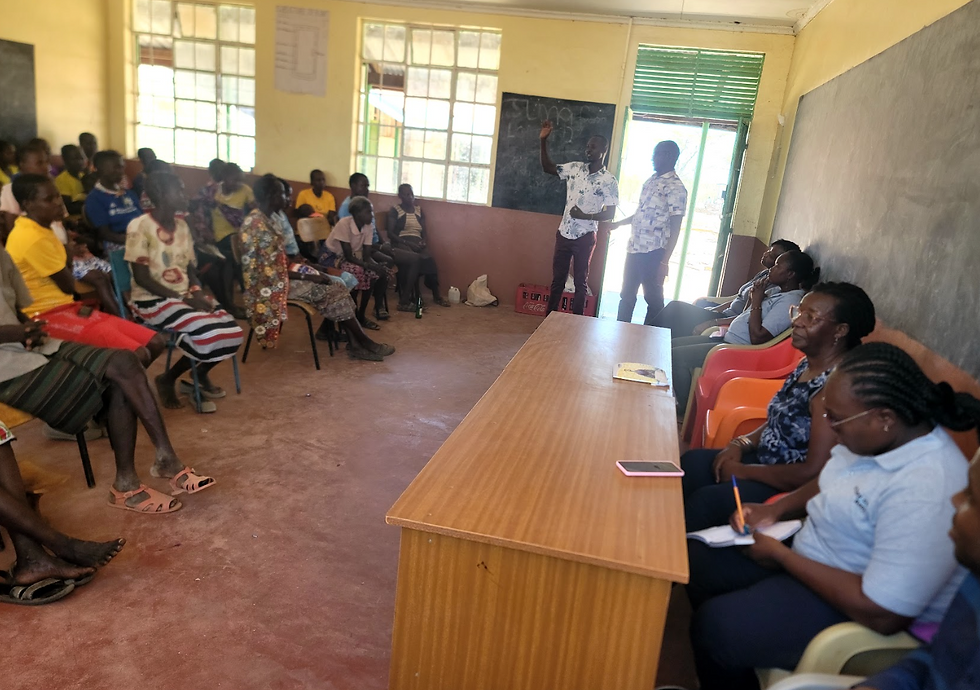
With significant coordination and support from So They Can, the faculty and staff at Katikit School, and members of the surrounding community, roughly 40 to 50 people came together for a community forum, about three quarters of them women, with many representing families living within several kilometers of the school.

We are incredibly grateful to everyone who helped make the gathering possible. A special thanks goes to the team at So They Can for their coordination and continued partnership, as well as to the faculty and staff at Katikit School and the community members who gave their time, shared their knowledge, and helped us better understand the place and the people who will ultimately shape this work.

The purpose of the forum was simple. Before making decisions about what the project should look like, we wanted to listen.
The conversation explored food production, water, fencing, livestock, education, and the challenges families face farming in a landscape defined by intense heat and long periods of limited rainfall. It also helped us better understand how the school can become a place where students and parents learn together and where practical knowledge can move beyond the school grounds and into surrounding farms and households.
One of the strongest messages came from the community itself. When asked about participating in the work required to establish the project, those gathered unanimously committed to contributing their labor without payment. That willingness to build something together is an important foundation for what comes next, and for the larger goals of strengthening food sovereignty and community autonomy through locally held knowledge, skills, and resources.
The emerging plan reflects both those conversations and what the landscape can realistically support.
Approximately seven acres will focus on dryland staple crop production using drought and heat tolerant crops such as millet, sorghum, pigeon pea, and maize. Water harvesting, soil building, Vetiver, and other regenerative land management practices will be integrated into these fields to make better use of the rainfall the site receives rather than attempting to depend on irrigation.
Closer to the school, approximately one acre will become an irrigated kitchen garden, agroforest, and food forest system. This smaller area will allow for more intensive production and perennial crops capable of providing consistent yields while also serving as a living classroom for students, parents, and the wider community.


We are also discussing how the project can become part of an extracurricular learning program at Katikit. The goal is to develop accessible resources that students and families can actually use, including workbooks and materials covering gardening, soil fertility, water and landscape management, growing and harvesting food, and culturally appropriate cooking and recipes. Wherever possible, these materials will be highly visual and pictorial, with resources available in both English and Swahili so that the learning is useful beyond the classroom.
The idea is that the garden and fields themselves become part of the curriculum. Students and parents can learn together, practice what they are learning on the land, and carry those skills and ideas back into their homes and communities. Over time, that exchange of knowledge can be just as important as the food produced at the school.
The goal is not simply to grow food. It is to build practical knowledge around how water moves through a landscape, how healthy soils are built, how crops and trees can work together, how food can be grown and prepared, and how agriculture can become more resilient in a difficult climate.
Food sovereignty and community autonomy ultimately depend on people having the knowledge and resources to make those decisions for themselves, and that is what we would like to see this project focus on.
Stay tuned for more details.


Comments